LOCAL-FIRST · OPERATIONS · REACT/TS
Victus Control
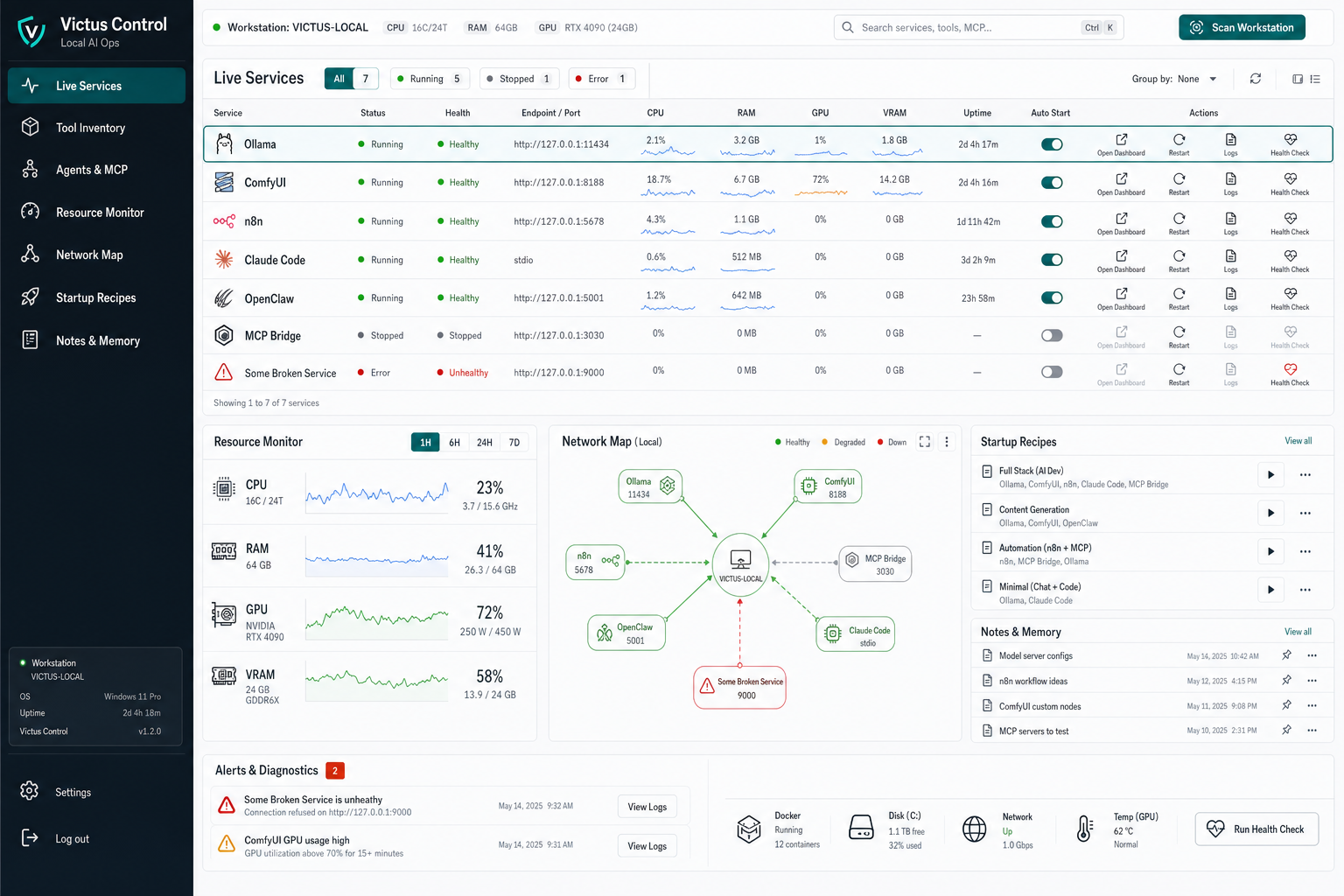
A local-first operations platform to understand, structure and manage an AI workstation: live runtime discovery, inventory, resource monitoring, security review and an intent map that compares your desired setup with reality.
RESULT
Shows at a glance the difference between your intended and your live setup — with no cloud dependency.
01 THE PROBLEM
A local AI workstation quickly turns into a tangle: models, automations, dashboards and tools spread across processes and ports. What's really running, what should be running, and where does reality drift from your intent?
02 WHAT IT DOES
- Live runtime discovery
- Scans running services and tools and shows status, health and resource cost per local AI tool — instead of separate terminals and guesswork.
- Intent Map — intended vs. observed
- Draw how your workstation is supposed to be and let Victus compare that with what's running live: OK, missing, exposed or unexpected. That difference is the core of the project.
- Resource monitor
- CPU, RAM, GPU and VRAM at a glance, so you immediately see where the pressure is during heavy AI work.
- Persistent inventory
- Remembers known tools with notes and status labels, even when they're not running — a living catalogue instead of a graveyard.
- Security review
- Unknown listeners end up in a review flow instead of quietly staying open; you decide what's trusted.
- Agents & MCP diagnostics
- Visibility into connected agents and MCP servers, on top of a testable React/TypeScript architecture with SQLite state.
03 WHAT I LEARNED
The interesting question wasn't ‘yet another dashboard’, but: let the user define the intended setup and compare it with the live reality. That difference — desired vs. observed — is where the real insight lies.
INTERESTED?
Let's talk.
Tell me what you think — or what you'd want to do with it.